
There’s a strain of contemporary dance that places all the emphasis on shapes and movement, the exploration of spatial possibilities as an end in itself. It can sometimes seem austere and unemotional, sometimes gloomy and apocalyptic.
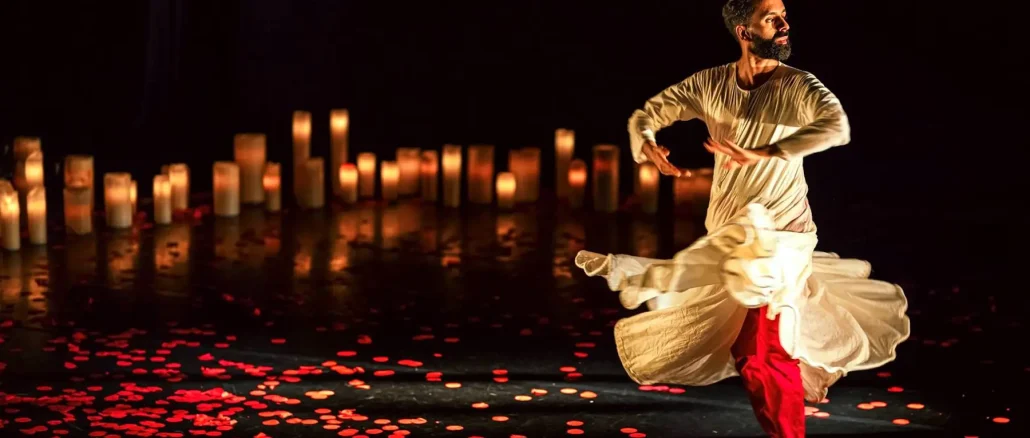
That’s not what you get from Aakash Odedra’s latest. A globally recognised artist and winner of numerous awards, his style is a unique synthesis of contemporary dance with classical Indian kathak – formal physicality combined with fluidity of movement and awareness of space. And Songs of the Bulbul is probably the best we’ve seen of Odedra’s work, an hour of beautiful, engrossing virtuoso dance from a single dancer that unashamedly embodies emotions – mostly joy, some reflection, a tinge of sadness and pain – in a piece that ultimately describes a journey towards unity with the divine that is the core of Sufism. You don’t have to believe in the spiritual to feel the story, though; the dancing, the choreography, the music, the lighting are all that good.
In Persian tradition the bulbul is the bird we know as the nightingale, famous for its melodious song and symbolising beauty, love, and even springtime in many cultures; poets like Hafez and Rumi also reference the bulbul for spiritual longing and the transient nature of life. The beauty of the bulbul’s singing is supposed to increase as it nears the end of its life, mirroring the way physical boundaries can be transcended as we move towards enlightenment and the divine.
No surprise then that it was highly prized as a caged bird to provide on-tap access to those images. During the initial stages of research and development for the piece that became Songs of the Bulbul, the choreographer Rani Khanam told Aakash Odedra this story; and it struck a chord.
Odedra says he’s always been interested in animals – “I find they possess a certain honesty that we, as humans, have learned to mask” – and he’s particularly drawn to birds. “To me, it is magical how they can take to the air, glide, perch, and, most of all, sing. I often wonder what they sing about. I do not understand the language, but there is a purity in it that touches something deep within me. Their song feels like a prayer – a worship of the sunrise and sunset, and a celebration of life in its entirety.”

To extract the most powerful melody from the caged bird, the bulbul underwent a gruelling process of ‘training’. “It was first placed in a pitch-black room so that it would sing out of a desperate longing for light to touch its feathers once more. This was followed by several harsh stages of deprivation. Finally, in the last stage, the bird’s eyes were removed. Blinded and broken, the bird realised its only remaining option was to leave its mortal body by singing one final, powerful, and melancholic song – leaving its earthly cage behind to transcend to a higher realm where it could no longer be confined”.
The story resonated with Odedra. “When we perform, we leave a small part of ourselves on the stage; one could say we die a little, until ultimately there is nothing left to give. On hearing the story, I felt the bird was no longer a bird – it was me. Its song became my dance, and my dance became its song.”
Songs of the Bulbul shows us this progress from within a minimal but highly effective set designed by Emanuele Salamanca that includes a bank of (electric) candles and endless rose petals. It’s all set off by Fabiana Piccioli’s exquisite, atmospheric lighting; watch out for the dramatic blinding sequence …
The score is by Rushil Ranjan (from the Orchestral Qawwali Project) that weaves classical Indian rhythms with modern orchestral textures. It’s a sumptuous, cinematic soundtrack loaded with hummable refrains and played (in a recording) by co-commissioners Manchester Camerata. Says Aakash Odedra: “While we were creating Songs of the Bulbul, I realised that the music would be the key to this world – I needed this story to be accessible to a global audience. I couldn’t think of anyone who could bridge the link between East and West better than Rushil Ranjan”.
Principal choreography is by Rani Khanam, a distinguished kathak dancer with more three decades of professional experience and numerous accolades to her name; Odedra always knew that he wanted to work with her – “I felt her dance and choreography spoke of a soul’s journey through life, I wanted to find a way to share with the world what I saw and felt in her presence.
“After the pandemic, my soul and body yearned for a change – a shift into a different physicality. I was longing for a metamorphosis, and in my mind’s eye, I could only visualise one person who could make this happen: Rani Khanam.
“We shared some of the choreography with Rushil, and he began to compose. There were moments where he sent music tailored to a specific scene, and we choreographed directly to it. We eventually spent three incredible weeks together as a full team in Sicily – living together, making music, plotting lights, cooking, laughing, and sometimes crying together. This beautiful connection is what truly brought the synergy of Songs of the Bulbul to life.”

The performance is brought to the Arts Center at NYU Abu Dhabi by the Bagri Foundation, a longtime supporter of Aakash Odedra’s work. Dr Alka Bagri, Trustee of the Foundation and a personal champion of Odedra’s practice, describes Aakash Odedra as an artist “whose dance unites extraordinary physical discipline with deep emotional and spiritual inquiry. Rooted in classical forms yet unmistakably contemporary, his movement is precise but porous – capable of holding stillness, vulnerability and intensity all at once. As a solo performer, he sustains entire emotional landscapes on stage inviting audiences not simply to watch, but to feel and reflect. This commitment to depth, authenticity and artistic courage is why our foundation chose to support him.”
Odedra has performed over 300 full length performances in 40 countries – including a number at NYUAD, where he has created and premiered two works specifically for The Arts Center. Indeed, he was part of The Arts Center’s first season in February 2016 with Murmur 2.0, an exploration of dyslexia through visuals, light, sound, and movement. The ensemble piece #JeSuis, a world premiere, followed in 2020. In 2022 Odedra presented a programme of solo pieces at Louvre Abu Dhabi (Echoes, Cut, and Constellation). And most recently there was another world premiere at the Arts Center, 2024’s Mehek.
“I feel as though NYU Abu Dhabi is like a second home,” he told us. “I have made many friends here over the years and feel as though I am reuniting with my ‘art family’. My very good friend Bill Bragin has been a huge support over the years, taking such a keen interest in both the work and the creative process.
“Equally, I have a strong personal connection to the Bagri Foundation, which has been an incredible supporter of my work for a long time. For me, having both of these wonderful organisations come together to host this show is a dream come true.”
Dr Bagri also finds a strong resonance with The Arts Center: “Bringing Songs of the Bulbul to Abu Dhabi was especially meaningful because the work speaks across cultures through shared poetic and spiritual traditions. Layered with symbolism, the bulbul’s song becomes a meditation on longing, freedom and inner voice. These are ideas that resonate strongly across the Middle East and South Asia. In a city shaped by cultural exchange, this piece offered a unique opportunity that affirms our belief in art as a bridge between histories, geographies and inner worlds.”
The Bagri Foundation has been championing arts and culture for over a decade, with a focus on projects that create dialogue between traditional and contemporary Asian arts. This work is delivered through two core strands: curatorial programming and grants. The Foundation has been part of Aakash Odedra’s artistic journey for many years, having previously co-produced and co-commissioned Mehek. This longstanding relationship led to a natural collaboration, culminating in bringing Songs of the Bulbul to The Arts Center.
The Guardian review described the piece as “a song of beauty and light and life”. We wondered if that was a fair description, or whether Aakash Odedra had a more explicitly spiritual intent for Songs of the Bulbul, suggesting a path beyond life.
In fact Odedra would probably say there is no distinction to be made between ‘life’ and something beyond it – it’s all part of the same continuum.
“For me, dance is a direct conversation with a higher energy, and Songs of the Bulbul is truly an extension of that realm. I work from the spirit and from the soul. Some may ask: what is the spirit or the soul? In my simple experience, it is the ‘unsaid’. It is the feeling you get when a musical note pierces you and leaves you speechless; it is the unspoken language where silence speaks louder than words.
“It also speaks to the path paved with difficulties and the effort required to overcome them. The bulbul keeps singing until the very end; to reach a certain level of personal freedom or spirituality, one must persevere. Through darkness, we find light, and in pain, we find sweetness.
“Songs of the Bulbul is also a reminder of the fragility of life and the inherent ‘humanness’ of being human – qualities that are often forgotten in our fast-paced world.”
Originally staged at the Edinburgh International Festival in 2024, Songs of the Bulbul has been touring in Britain to rave reviews (we saw it somewhat arbitrarily in Norwich). After Abu Dhabi it moves on to three dates in Australia and one in Florida.
Songs of the Bulbul is in The Arts Center’s Red Theater at 7.30pm on Sunday 18 January; tickets are AED 105 (get in quick, they’re selling fast – and deservedly so). The performance will be followed by a Q&A with Aakash Odedra and Dr Alka Bagri. Details are here.

Be the first to comment