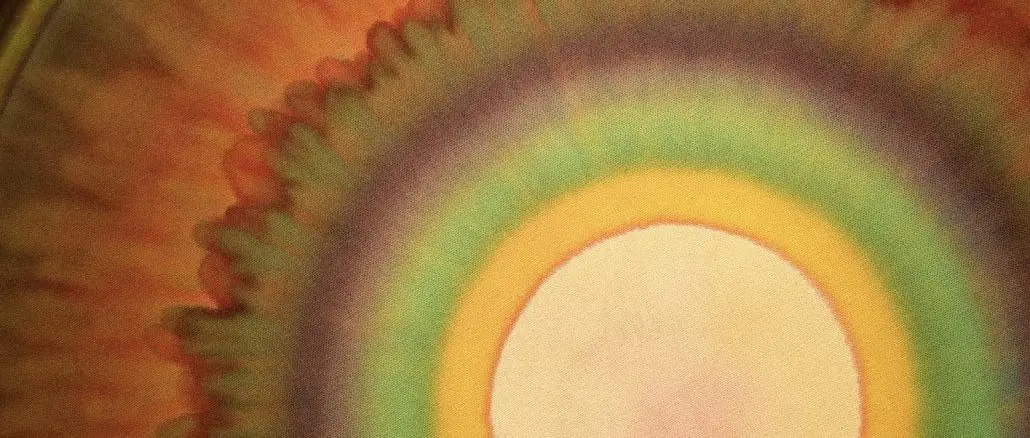
Detail from New sunlight (2026)by Olafur Eliasson, shown by neugerriemschneider at Art Basel 2026
The Art Basel & UBS Survey of Global Collecting 2026 is another piece of research from Clare McAndrew’s Arts Economics, which means both the data and the conclusions are likely to be sound.
It’s the 13th such survey, based this time on 3,100 high-net-worth respondents across the US, UK, China, Hong Kong, France, Australia, Germany, Japan, Brazil, and Singapore. It covers how they collect, what they spend, how they share their collections, and what they expect from the market.
The important caveat of course is that this is a numerically small group of very affluent and highly engaged buyers who are already active in the art market – so we can’t draw any conclusions about every kind of art collector, let alone the population at large.
And the survey includes collectors’ self-reported spending and behaviour; but it doesn’t estimate what share of the total art market its respondents are responsible for, so maybe we can’t draw too many conclusions about the overall impact of these people.
Still, the findings do describe the motivations and sentiment of that group. So here are the headline points:
Collectors seem to be optimistic but more cautious More than half of respondents expect the fine-art market to grow, yet the share who bought work by a newly discovered artist fell from 66 percent in the 2025 survey to 45 percent this time – and that’s a five-year low. Purchases are shifting toward established artists.
Collectors want distinction“Uniqueness and rarity” was the leading ownership priority for 43 percent, ahead of expert approval (23 percent) and recognition among fellow collectors (22 percent).
Gen Z is where the heavy action is Gen Z HNW collectors are now the market’s biggest spenders, rather than simply an emerging audience. There aren’t many of them – just 279 of the 3,100 respondents fell into the Gen Z 20 to 29 age group– but Gen Z buyers accounted for more than twice the average fine-art spending of older generations; 13 percent of them spent over $1 million on fine art in the first half of 2026, compared with 3 percent of the sample overall. On average each Gen Z collector spent $347,460 in 2025, up 19 percent year on year and nearly three times the survey average of $124,265. The report notes drily that these averages are influenced by a small number of very high spenders (Incidentally, the preference for “uniqueness and rarity” was strongest among Gen Z: 48 percent, against 38 percent of Boomers.)
Collectors want discretion Only 10 percent wanted any kind of broad recognition as collectors; more than two thirds preferred to keep ownership within their household or close circle. Among those lending to museums, most preferred anonymity or at most “discreet” acknowledgment (nearly a quarter planned to donate works to museums or charities in the next year, though).
Art can be good for collateral 19 percent planned to use art as loan collateral, and about the same proportion had already borrowed against art. This obviously relates to buying safer artists and then loaning out the works – if you’re interested in art as an asset class, it might as well be put to work. What’s the point of just parking it over the fireplace?
There were two other conclusions in the report that stood out for us.
Art buying is increasingly direct and digital Dealers remain the most-used channel, but 69 percent of buyers bought directly from artists – more than double the 2024 level. Collectors also report growing use of digital advice and AI tools, basically as extra routes to discovery in a market where dealers and fairs still dominate transactions. A hybrid of increasingly sophisticated self-education alongside conventional professional relationships might well be the model for the next few years, and it will be interesting to see how fairs and dealers accommodate it.
It’s a nepo baby business 72 percent of respondents said they had inherited artworks, which presumably gave them either or both of a taste for art and a useful source of collateral. Only 15 percent said family was their primary source of wealth, but definitions of ‘wealth’ might be open to debate …
There’s much more detail (too much?) in the Art Basel & UBS Survey of Global Collecting 2026. A PDF version is available for free download here.

Be the first to comment