
The Biennale Architettura is probably the hottest event in the architectural calendar. Big ideas and big ambitions, pavilions with national pride at stake, the beautiful and well-heeled in attendance (though it’s not as glitzy as the art biennale), big brand partnerships everywhere (Norman Foster and Porsche have designed a shimmering bridge cum jetty, Jean Nouvel showed design concepts for the Fondation Cartier’s future spaces, Rem Koolhaas designs are at Fondation Prada). Prosecco, Negronis and Campari spritzs are widely available, not to say mandatory. And Venice is the backdrop. What’s not to like?
This year’s curator, Italian architect Carlo Ratti, is something of a tech enthusiast: he founded the MIT Senseable Cities Lab, which uses technology to speculate about the future of urban design, and the bit of the Biennale that he personally curated is full of data-driven tech-could-solve-everthing ideas. His ambition apparently is to present architecture that embraces a combination of artificial, natural and human intelligence – “hybridising different types of knowledge”, as he put it in an interview – but there’s rather more AI than nature on show in his choices.
The fashionable US design studio Diller Scofidio + Renfro won the Golden Lion for best participation in the Architecture Biennale for the Canal Café project (below), a complicated gismo which purifies water from the Venice canals to make coffee for visitors. That’s undoubtedly on point, definitely the kind of thing that will have appealed to Carlo Ratti.

Certainly Venice’s waterways are notoriously polluted (though improving), but to us it seemed a bit of a sledgehammer to crack a nut. Or maybe a clever use of design and technology to solve the wrong problem – fixing the pollution in the first place might be a better option. Still, the jury took the view that the project was “a demonstration of how the city of Venice can be a laboratory to speculate how to live on the water, while offering a contribution to the public space of Venice”. And the coffee is (a) a decent price, at €1.30 for an espresso and (b) reportedly very good …
And if the tech bro brilliance gets you down – in truth, it’s not especially inspiring – there’s always Venice itself to contemplate.
The 65 or so national pavilions also provide a fine antidote to the esoterica. It’s a good year for these, especially those that apply some wit to the issue – Poland has a survey of building security from CCTV to lucky horseshoes: Estonia wrapped an old building on the Venetian waterfront in bright white insulation panels to comment on quick-fix solutions: Uzbekistan is celebrating the Heliocomplex, an epic solar furnace capable of heating to over 3,000 degrees and built as long ago as 1981.
Then there are the more specific solutions. Iceland, a country basically built on lava, shows how lava can make sustainable building materials. Austria is showing off Vienna’s genuinely impressive social housing. The Canada pavilion features alien-like structures coated in live cyanobacteria, which sequesters carbon from the air to biofabricate buildings. Australia has a curving earth-and-plaster wall, a physical form that is specifically designed to encourages dialogue.
But this year’s Golden Lion for Best National Participation went to Bahrain for an exhibition titled Heatwave (below). This was curated by another very hip incomer, architect Andrea Faraguna of the Berlin-based studio Sub, which has become something of a thinktank for contemporary design culture. The Bahrain project isn’t as out-there as some of Sub’s designs, being a proposal for the design of public space in hot countries that utilises passive cooling strategies rooted in Bahrain’s climatic realities and cultural context; wind towers and shading are integrated with advanced engineering (a geothermal well brings in cool air from underground, a solar chimney expels warm air to the outside) to provide adaptable public spaces that mitigate the effects of extreme heat while promoting social interaction and community resilience (there’s a particular focus on construction sites).
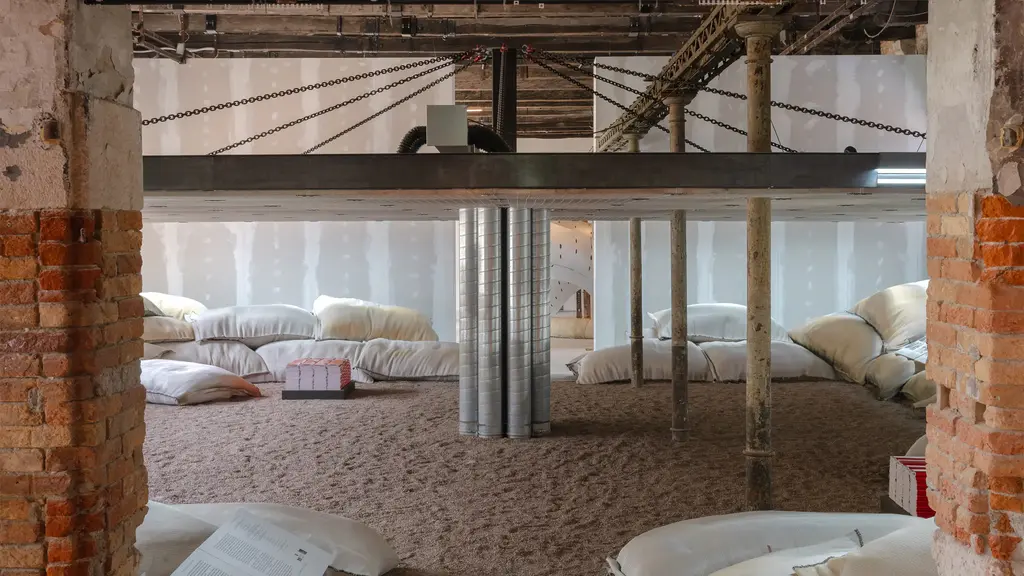
The jury praised Heatwave’s “viable proposals for extreme heat conditions”. But while tapping cool air from underground is a neat idea, we weren’t so convinced about the award. It’s true that dealing with increasing temperatures, especially in already hot places, is a necessary concern for architecture these days, but there didn’t seem to be too much pushing of the envelope here.
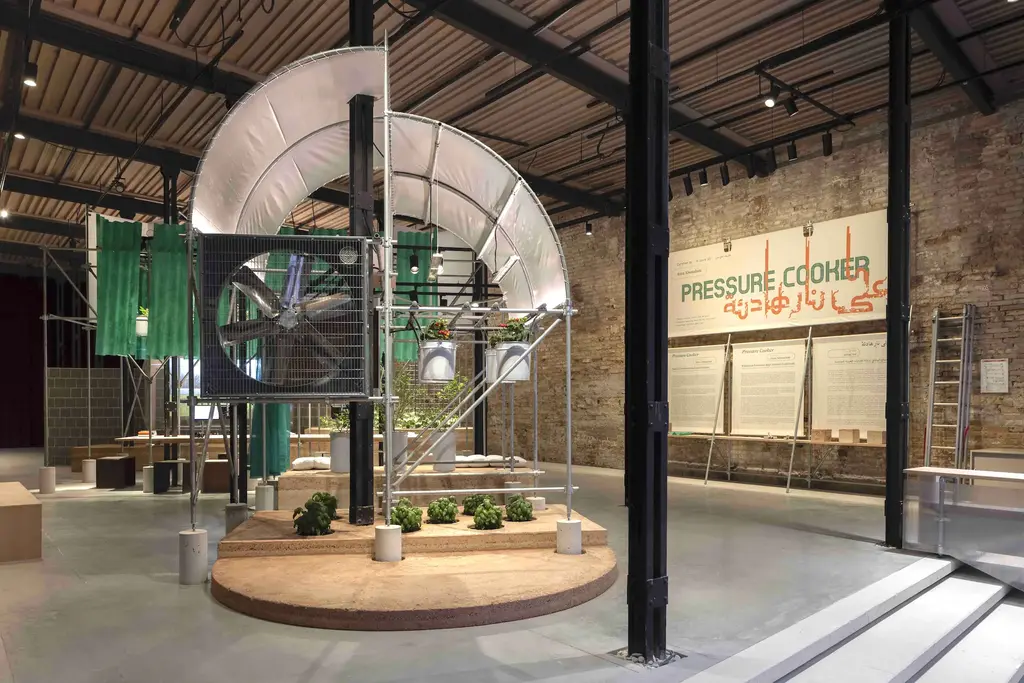
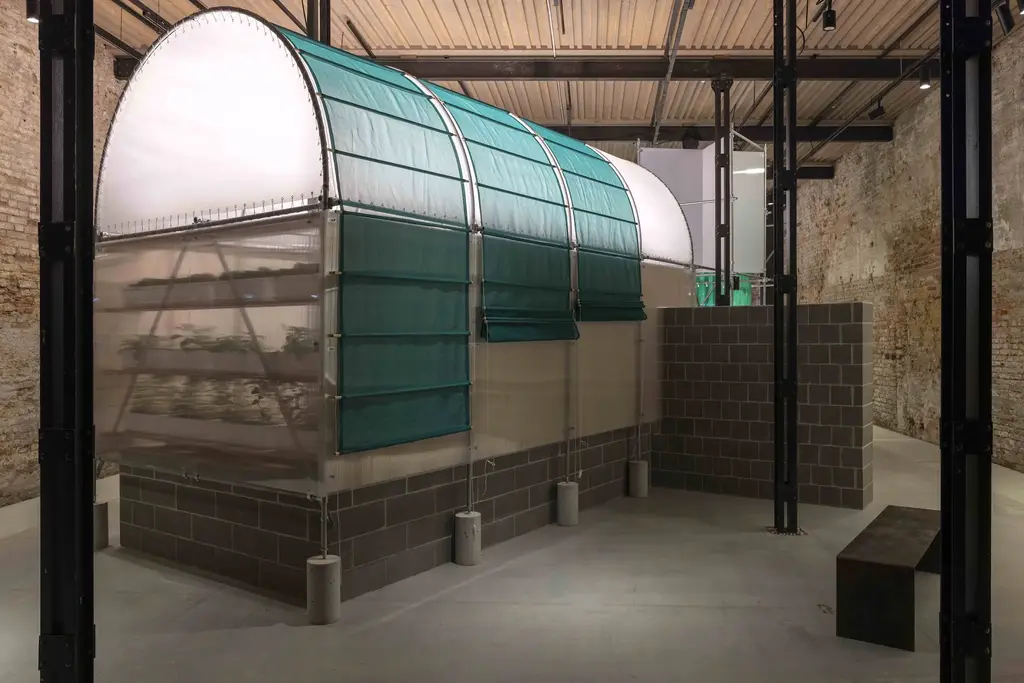
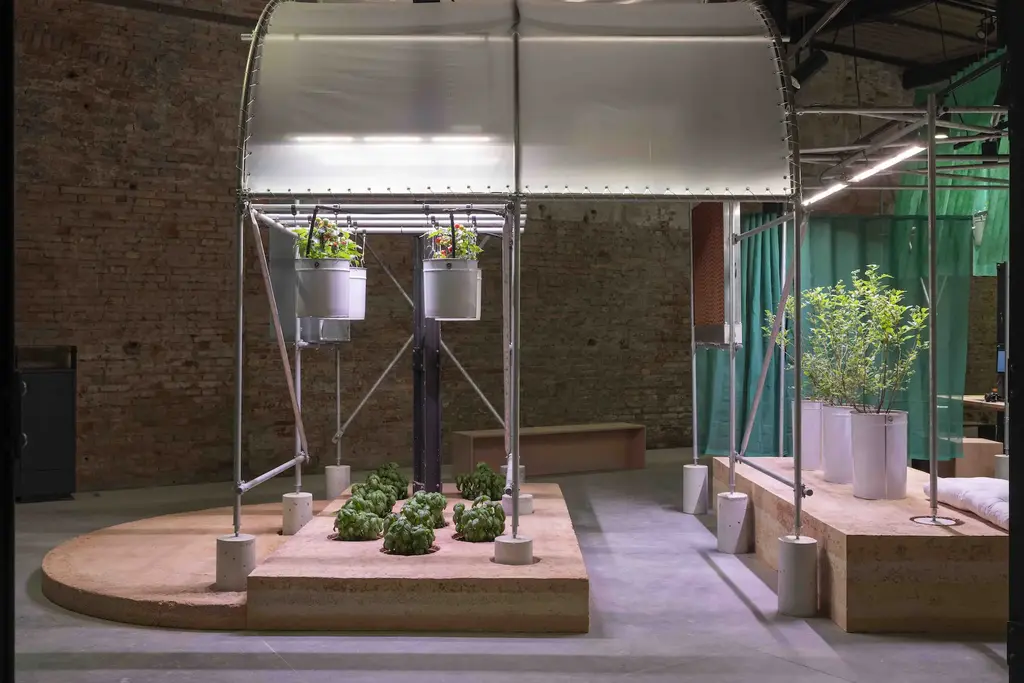
Which brings us to Pressure Cooker, the UAE pavilion’s exhibition, which effectively proposes a redesign of the envelope by asking a big question: how can architecture be mobilised to contribute towards greater food security? Or to put it more specifically: as climate change disrupts agricultural systems, traditional farming methods face mounting threats from soil degradation to temperature extremes – so what can architecture do about it?
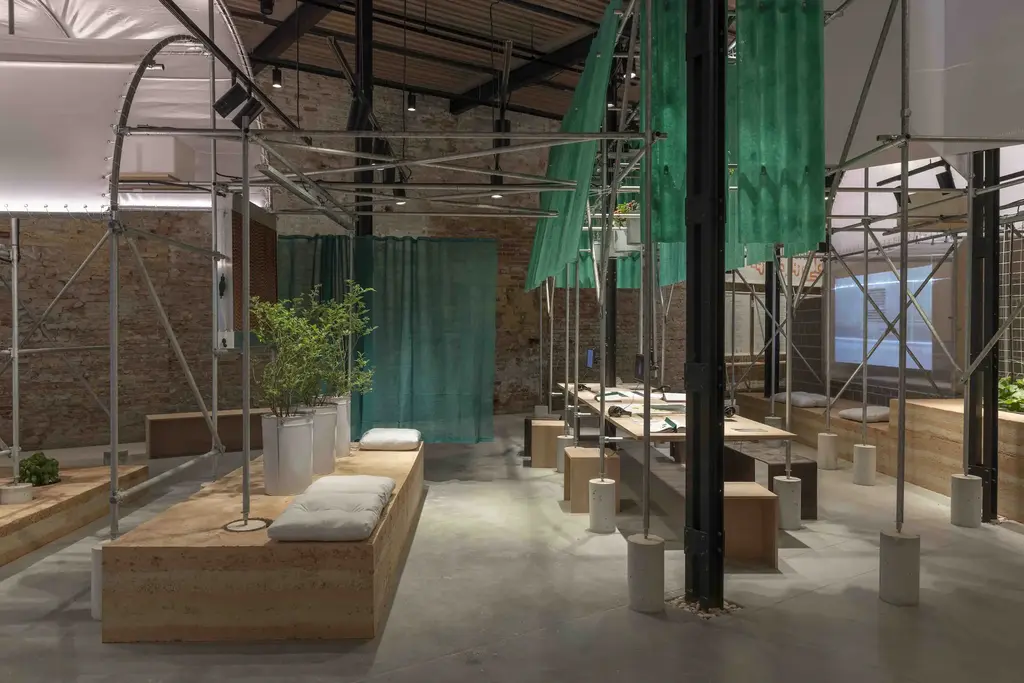
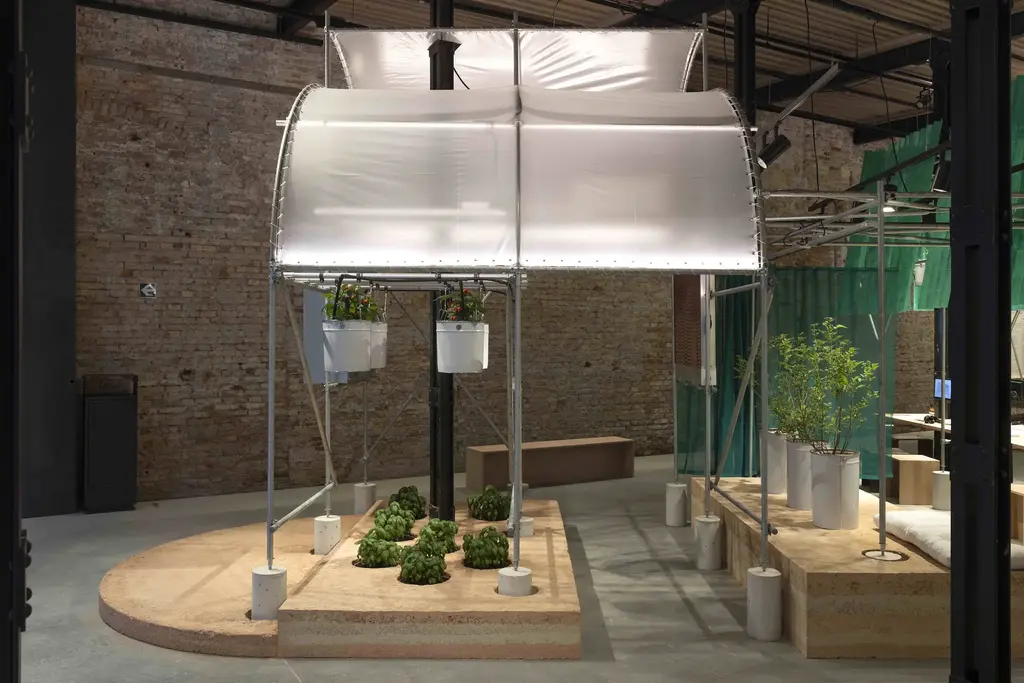
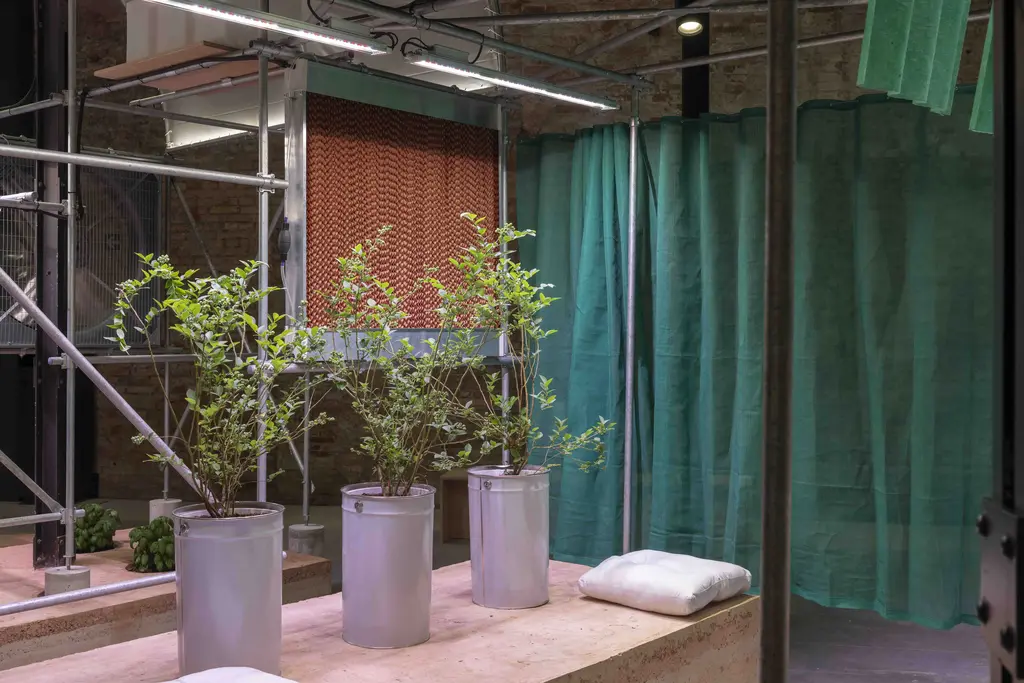
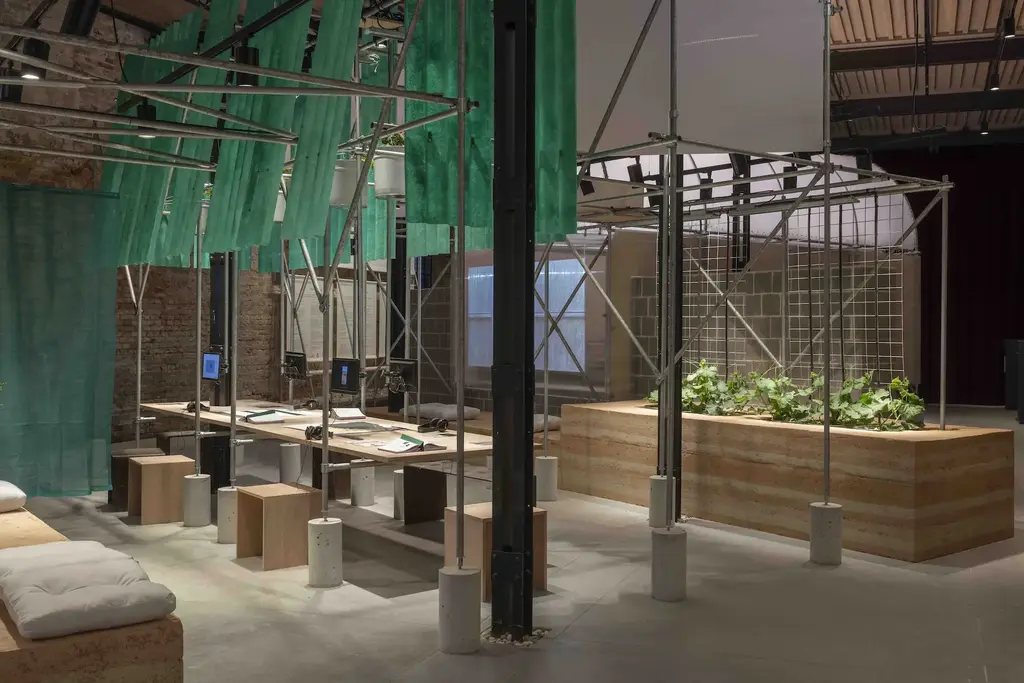
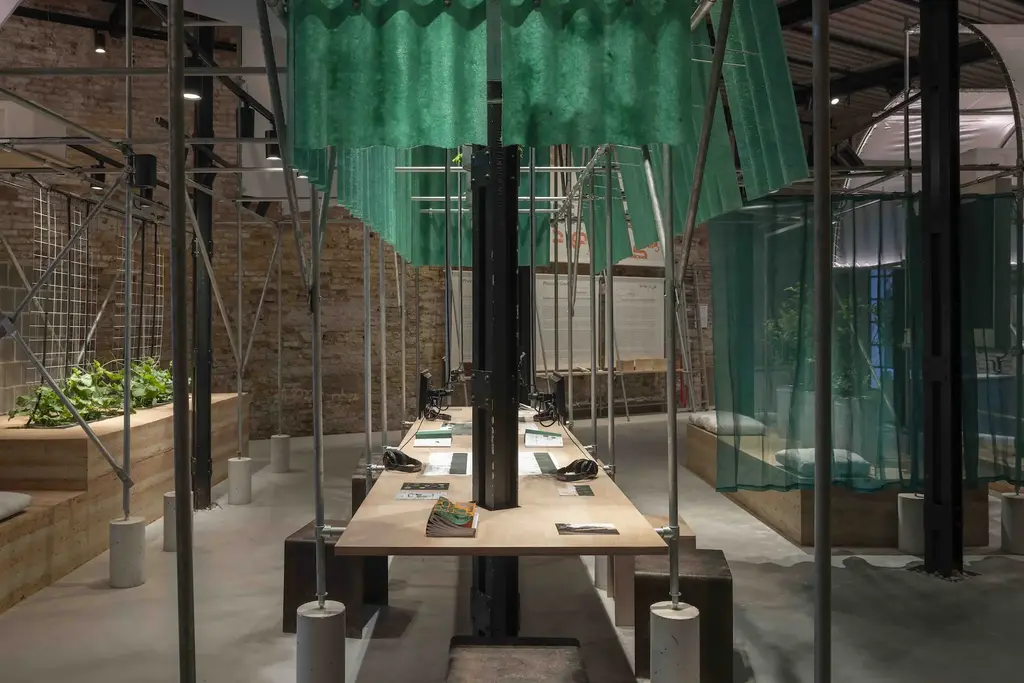
The exhibition is a research project that looks at existing food-growing infrastructures in the UAE – basically, climate-controlled greenhouses – and proposes what amounts to a kit of parts for greenhouse-type structures that suit the UAE’s hot arid climate, fit the cultural milieu, and deliver the appropriate foods. The exhibition explores the possible architectural forms that these micro-climatic conditions could generate, through multiple scenarios of input, output, and assembly.
The ‘kit’ of basic components – roof, wall, floor, tools, materials – can be reconfigured into different combinations that respond to specific climatic conditions and crop requirements. As the press release puts it, “The approach proposes a future in which food production and architectural form are intertwined and can be integrated throughout our built and lived environments”.
The exhibition actually comprises a series of experimental greenhouses constructed using different combinations of the kit’s components to explore how inputs (such as sunlight, shading, external temperature, irrigation, ventilation, and thermal mass) and outputs (interior temperature, light levels, humidity and energy use) can be varied through architectural form for a variety of desired outcomes (producing different foods).
So Is architecture the answer to aridity? Or would that just be imposing a manmade solution on to a more fundamental ecological problem? Can we build our way to a better future?
We put those questions to Azza Aboualam, the architect who is the curator of the UAE’s exhibition and leader of the team responsible for the core research. She more or less agreed with the last of those points: “Yes, we can use research to help build a better future and to enhance national food production agendas. We could use it to help proliferate an understanding of where our food comes from and how to interact with it – potentially even building better cities through it”. But she doesn’t believe that man-made solutions are the sole answer. “When it comes to the ecological problem, we can lean on architectural solutions to help – specifically, in this project, when it comes to enhancing local food production. This project is not the sole solution, but it could act as a means to help”.
She regards Pressure Cooker essentially as a possible step forward in food security and food self-sufficiency. “It’s not that the desert is separate from our lived environment – it is all one. So, framing it as a harsh environment that is hard and impossible to live in constitutes a negative perspective that is not entirely true. We should not look at it as the enemy or the other; it is our home. So the question we are really posing here is: how can we live with the desert environment? Especially when it comes to tapping into architectural solutions that we might be able to lean on?”
She sees the Pressure Cooker exhibition as marking a moment in the timeline of the research – “essentially reflecting how far we have come in the archival work, fieldwork, technical research, and design-build process, grounding it within the Biennale’s platform. The ambition is for the project to continue and grow, as I truly believe the speculations presented in the exhibition have the potential to be integrated into our lived environments. One of the assemblies already exists in my backyard in Sharjah, which gives me hope that it can be more widely adopted – not only across the UAE, but in other arid regions as well.
“This potential also shapes how the work is perceived in the exhibition space. There is often a sense of recognition: someone might say, ‘“’Oh, I have seen something like this on my uncle’s farm’ or ‘That looks like what my friend has in their backyard’. There is a visual familiarity that people connect with.
“At the same time, I always emphasise that even though these assemblies may look familiar, they involve variations, new approaches, and architectural modifications that make them distinct. This sense of approachability has been a positive element, and the feedback and interactions we have received so far have been both encouraging and constructive.”
So is the ‘kit of parts’ solution a commercial possibility? Aboualam says she still needs more data to assess the feasibility of the technical components of the tool and to determine whether the outcomes her team has observed are accurate and reliable in real-life scenarios. But “we are currently in conversation with other partners who could potentially support both the data collection and the expansion of the system’s application, possibly scaling it up to the level of a farm, or even a city. We aspire for the domestic and neighbourhood scale systems to feed into the city scale through these partners.”
Now that seems to us to be the essence of architecural imagination at the sharp end of climate change: adaptation with adapatability, imagination with practicality. There’s always room for technology, for creating and managing spaces for living and working, for theory and experiment. But sometimes you come across something that make you think, “Yes, that could work”. And that’s enough.
The Biennale Architettura 2025 runs to 23 November at the Giardini and the Arsenale in Venice. The National Pavilion of the UAE, which houses Pressure Cooker exhibition, is a permanent space in the Arsenale., The Biennale is open 11am to 7pm (10am to 6 pm from 30 September on) every day except Mondays; a one-day ticket is €25, but a three-day pass (valid for three consecutive days) is a better bet at €35. Details are here.
Be the first to comment