

Sharjah Art Foundation announced Aziz Hazara, Pallavi Paul and Pratchaya Phinthong as winners of the Sharjah Biennial Prize during the opening gala dinner of the Biennial’s 16th edition last week (no, we weren’t invited, since you asked).
The winners were selected by architect/curator Paula Nascimento, co-curator of the award-winning Angola Pavilion at the 2013 Venice Biennale; Eungie Joo, formerly Curator and Head of Contemporary Art at SFMOMA, and curator of Sharjah Biennial 12 (2015); and Gerardo Mosquera, one of the Havana Biennial founders and co-curator of the 2021 Guangzhou Image Triennial.
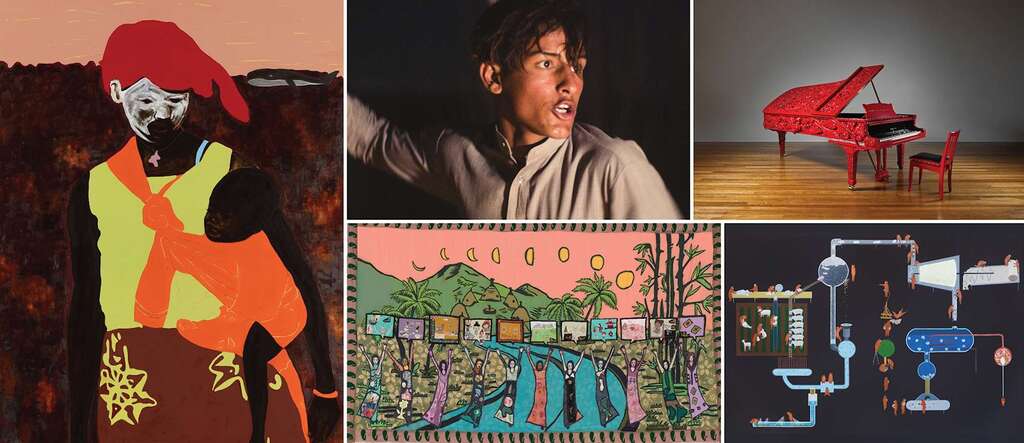
Aziz Hazara has a modest yet dynamic installation in the Old Al Jubail Vegetable Market to chronicles the afterlife of Bagram, site of notorious US and NATO military installations during the Afghan war. Hazara’s I Love Bagram (2025 – above), Bagram Field Notes (2021–ongoing) and other works ruminate on the impact of military intervention through what is left behind – clothing, tools and other everyday goods, creating a radical archive of knowledge and resistance.
In her contemplative installation comprised of Reckoning (2024), Afterglow (2024), and the film How Love Moves (2023), Pallavi Paul shows us how life exists in death and death in life. Her moving film portrays gravedigger Shamim Khan, who together with his colleagues buried more than 4,000 people who lost their lives due to COVID-19 and the ethno-nationalist violence that followed the Delhi riots in 2020.
Off the UAE’s coast, divers working with Pratchaya Phinthong have installed an underwater steel structure connected to a solar panel. Slabs of coral brick ‘harvested’ from the walls of the heritage area serve as a bed for repopulating coral in the Gulf. Together with 10 granite solar panel sculptures placed around Sharjah, his work We are lived by powers we pretend to understand (2024) reflects on art, science and the true meaning of heritage.
SB16 looks at how we navigate life within spaces that are not our own and how we respond to these spaces through the cultures we hold. The title ‘to carry’ asks what we bring with us when we travel, flee, survive or stay; “the Biennial therefore becomes a space for collective wayfinding, helping audiences make sense of the world by reflecting back, inwards and across in times of transition” says the press release.
The works in the Biennial – more than 650 of them, including more than 200 new commissions – are presented alongside a programme of activations, performances, music and film in more than 17 venues across the Emirate of Sharjah, including sites in Sharjah City, Al Hamriyah, Al Dhaid and Kalba. Free and open to the public, Sharjah Biennial 16 runs from 6 February to 15 June. More details are here.
Be the first to comment