
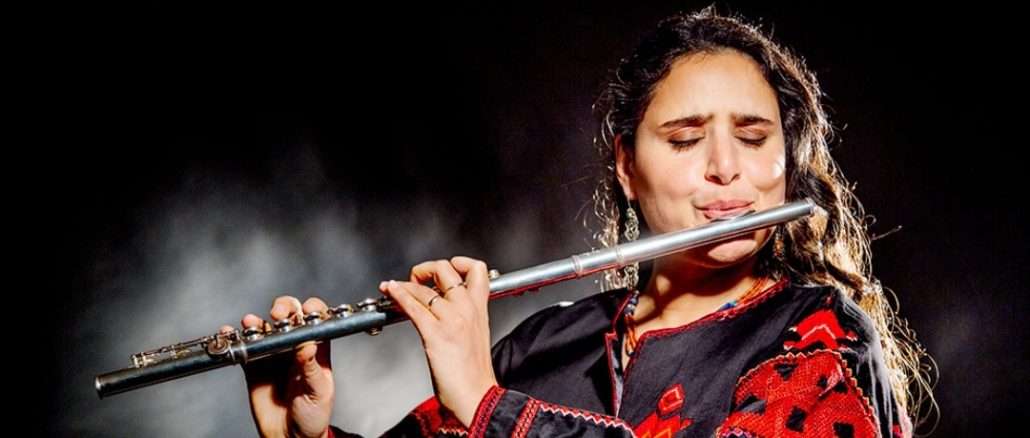
The Arts Center at NYUAD likes to give us the unexpected. The UAE debut of Naïssam Jalal and Hazem Shaheen promises just that – an intimate, meditative evening of taqsim and jazz improvisation from two masters of their instruments. The unusual feature is that those instruments are the oud and the Western classical flute, not traditionally seen in combination – especially in jazz.
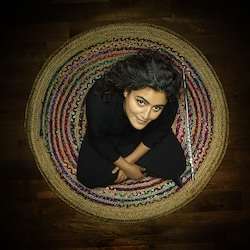
A star on the jazz flute, a prolific composer, leader of at least four groups, with two film scores and nine albums to her name, Naïssam Jalal (right) is established as a leading figure on the contemporary jazz scene. She also has a spectacular ability to make connections between different musical cultures, finding synergies easily and making exceptional music.
Born in Paris to Syrian parents, Naïssam Jamal had a background in Western classical music; she entered the conservatoire at age 6 to study classical flute.
She left the conservatoire at 17 after discovering improvisation. “Improvising allowed me to express things I can never say with words” she told us. “I could tell what was in my heart – which I couldn’t when I was interpreting someone else’s music”.
Her parents are painters, and that must have affected her relationship to the world – “yes, I think I am very sensitive to colour and light in music as in landscapes because I was raised surrounded by abstract paintings” – but it’s definitely in music that she finds her inner self.
And it’s not just one kind of music: in her storied career she moves easily between styles – Arabic taqsim and maqam, improvised and composed Western jazz, Sufi and Hindustani-inflected material, hip-hop, even rap collaborations. And there will be more to come: “there’s a lot I haven’t done. A lifetime won’t be enough for me to meet all the amazing musicians I would love to meet and play with!”
All that skipping between genres requires a lot of technical changes – there are so many differences in scales, time signatures, and so on. For instance, she’s a virtuoso on the ney, the end-blown flute that has a long history in Persian, Turkish, Arab, and Egyptian music. It looks like her principal instrument, the side-blown Western concert flute, but the two require very different breath, embouchure, and playing methods generally.
So given the sheer range of styles in which she is comfortable, how would she describe herself as a musician? Well, clearly she doesn’t feel the need to define herself in those terms. “When I play I always sound like myself. I have learned a lot, listened a lot, tried to understand different cultures, different relationships to the world, different languages. And I do my own thing out of this, even though you might hear many cultures in my expression …”
Similarly, she’s able to bridge from the harmonic and rhythmic logic of jazz improvisation to the notionally similar but undoubtedly rather different style of taqsim. A jazz solo has chord changes and meter; taqsim has no rhythm, no chord changes, and no fixed length. Says Jamal: “I am not pretending to play traditional taqsim. But I am a very modal musician – I have never played tonal music after my western classical music studies, and modality is where I feel absolutely free. Once again I am just doing my own thing inspired by many traditions”.
And how much of her music is about identity and belonging as opposed to simply following her ear wherever it leads? Again, she doesn’t see any difference. “Both are the same somehow – my identity is following my music and my music is following my identity, identity is changing with the music and music is changing with identity. I only belong to myself and the divine.”
That feeds into her stage work too. Improvised music leaves a lot of space for risk and failure in front of an audience, but there’s no jeopardy in performance. “I feel absolutely free, I feel excited, I feel confident. I am playing everything with my heart so even if I make a mistake it will always sound true.”
As for the mastery of those two very different wind instruments, “it’s a bit mysterious for me too!”
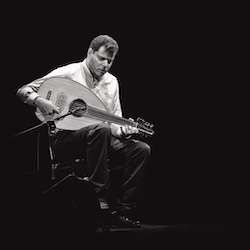
She met Hazem Shaheen in Cairo in 2006 and she says she was “mesmerised” by his playing. The feeling was mutual: “it was obvious that we needed to play together”.
Shaheen is an Egyptian oud maestro and composer, one of the first graduates of the Oud House project and subsequently a teacher there. In 2005 he formed Iskandarella, an Egyptian amplified-oud band with a kind of jazz-folk vibe that played many of his original compositions; he’s worked a lot with Ziad Rahbani, has composed soundtracks for several short films, and regularly plays festivals and performs concerts.
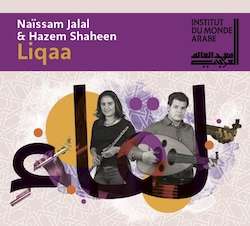
So it was a meeting of established talents. The first concert for Naïssam Jalal and Hazem Shaheen was in Egypt a couple of years after their first encounter; subsequently they performed in France for several concerts in 2011, and they recorded an album, Liqaa, that was released in 2016 (it was entirely typical of Jamal’s career that the same year also saw her release Al Akhareen with Palestinian rap singer Osloob).
Liqaa – ‘meeting’ in Arabic – is a two-instrument tour de force that includes politically-engaged pieces, notably Gaza sous blocus, but is ultimately a meditative and lyrical suite centred on life and the vicissitudes of fate.
Given the pace at which Naïssam Jalal works, and how much she is in demand, it’s perhaps not too surprising that the two haven’t played together as a duet since then – their Ramadaniyyat gig scheduled for NYUAD earlier this year had to be postponed because of the Iran conflict. “We are both very excited to meet again and play this music together after so many years,” says Jalal.
The evening will surely include updated versions of some of the pieces first heard in those French concerts and showcased on Liqaa. Jalal told us she won’t be compromising on her beliefs, both political and spiritual. And she left us with this: “We listen to each other a lot while we are playing together. The most important in playing music with anyone is listening. Even when you play alone!”
Naïssam Jalal and Hazem Shaheen play The Red Theater at The Arts Center on Friday 9 October at 7.30pm. Tickets are the usual AED 105; details are here.
Be the first to comment