
The UAE may be something of a laboratory for change, a still-young country building nationhood and reputation at speed with all the resources it can deploy without the baggage of a complicated past and a complex set of competing ideologies and entrenched positions.
India represents another approach to change. It’s clear that the country’s size and resources are making it a key player on the international stage. But to realise its massive potential, it has to wrestle the world’s largest democracy through a forest of competing demands from history, geography, religion and tradition, soaked in factional politics, bedevilled by local and structural inequalities.
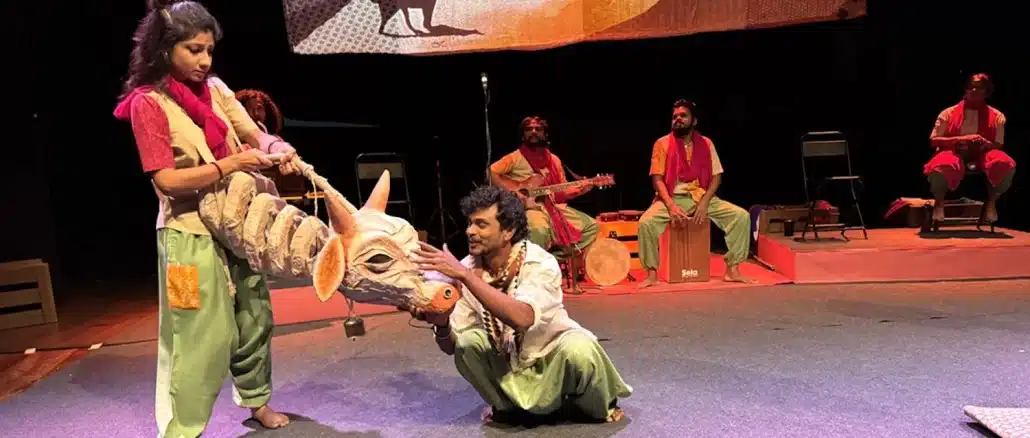
But change is happening in India; and that’s the subtext of The Arts Center’s upcoming presentation of Kavan. “Poetry and songs about young Ambedkarite experiences” is the content summary. But the lessons drawn are wider than that: “where do we go when the boundaries between right and wrong, sacred and profane, personal and universal, are blurred?”
Kavan aims to provide some clarity, a 150-minute performance that attempts to encapsulate an ambitious country full of contradictions and marginalisations by proposing a political judgement on inequality.
Kavan is the story about a young man, called Bejul, whose father is a Lok Shahir, an Ambedkarite people’s poet. After Bejul’s father gets killed, his religious mother dissuades him from following in his father’s footsteps. The play is about Bejul becoming a Shahir, a politically-aware performance poet; it’s a journey from acceptance of the status quo, including compliance with the social norms like gender and caste, to a gradual realisation that many of the constraints in his life are actually man-made and not predetermined.
Brecht demonstrated that this kind of political argument doesn’t have to be humourless or sententious. Kavan is an opera, a story delivered exclusively via songs (around 20 of them in total) and a strong musical envelope; the music moves from traditional to folk, classical to rock. “Shahiri Jalsa provided our structure,” says the director Abhishek Majumdar. “Jalsas are songs of the Dalits, Shahiri is the performance form, both are associated with Ambedkarites. Over time Jalsa has also borrowed from outside music. So we leaned into it, with all its contemporary and modern influences, and created the piece out of that.”
Kavan is also described as ‘an operatic satire’, and that was important to the feeling of the work – “a tone of not bitterness or anger, but of playfulness, of critique. Which is what satire can do very well …”
Kavan is a collaboration between the Mumbai-based music and street theatre group Yalgaar Sanskrutik Manch, whose work centres on caste, inequality and social justice; and the Nalanda Arts Studio from Bengaluru, run by Majumdar. He had met the head of Yalgaar, Dhammarakshit Randhive, on a different project, and there was immediate synergy; so the two started to work together on a collaboration. Ten months of workshops, exercises, and discussions about style, form and content eventually produced a decision about the format – a story told in song and poetry – and the storyline itself (written by Sudesh Jadhav) which was turned into the script by a number of writers. The music was developed in parallel with that, by MD Pallavi working with members of the cast. Its first performances followed in February 2025 at Prithvi Theatre Mumbai with the support of NYUAD School of Arts & Humanities and The Arts Center.
Kavan is described as an ‘Ambedkarite Opera’, Ambedkarism being the set of ideas associated with Dr Babasaheb Ambedkar (1891-1956). An Indian economist, barrister, social reformer, and political thinker and activist, he chaired the committee that drafted the Indian Constitution and was the country’s first Minister of Law and Justice. Ambedkar was born into a Dalit caste, whose members were treated as untouchables and subjected to socio-economic discrimination; he devoted his life to criticising the caste system and passionately believed in individual freedom.
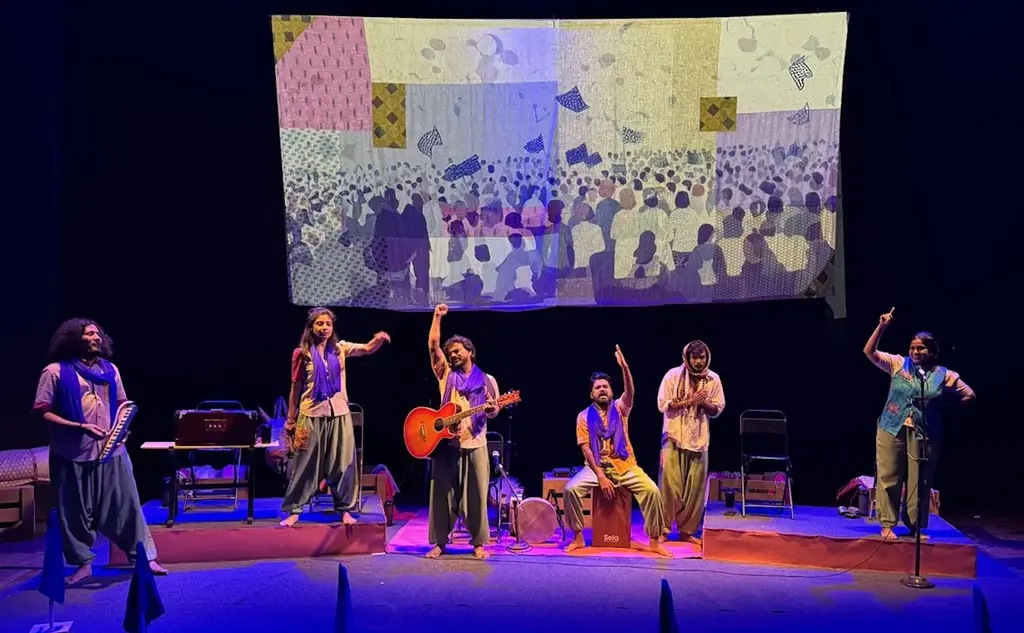
Yalgaar Sanskrutik Manch was formed in 2015, inspired by Babasaheb Ambedkar’s vision of cultural reform preceding political change to address caste-based social oppression. The Ambedkarite philosophy as presented in the show starts by recognising that caste is a man-made thing, not something embedded in destiny as Hinduism would see it. But as Abhishek Majumdar says, the Ambedkarite angle is emblematic rather than essential. “We don’t assume that the audience will have prior knowledge of what is meant by Ambedkarite. For our international shows we do have a brief explainer about caste, but inequality is something that is universally understood – it’s there in every culture and every tradition.”
As for the title, Kavan refers to poetry that is spoken rather than read or written – a performance tradition for the so-called lower castes. These are poems of the people …
And reaching the people is important to Abhishek Majumdar. “We want to reach as wide an audience as possible,” says Abhishek. “So we have different formats for different sizes of audiences and performance space. We can perform anywhere and everywhere, under the shade of a tree or in an elite auditorium space. And we put in a lot of effort to ensure that we perform to a mix of people.
“A satirical opera gives us a way to speak about deep-rooted inequalities in society – and every society has such inequalities – in a way that could also be accessible to people who actually may not want to hear about such things”.
Kavan – An Ambedkarite Opera is in The Arts Center’s Black Box on Friday 13 February and Saturday 14 February at 7.30pm and Sunday 15 February at 2pm. Tickets are selling fast but some are still available here at The Arts Center’s usual AED 105 per seat.
Be the first to comment