
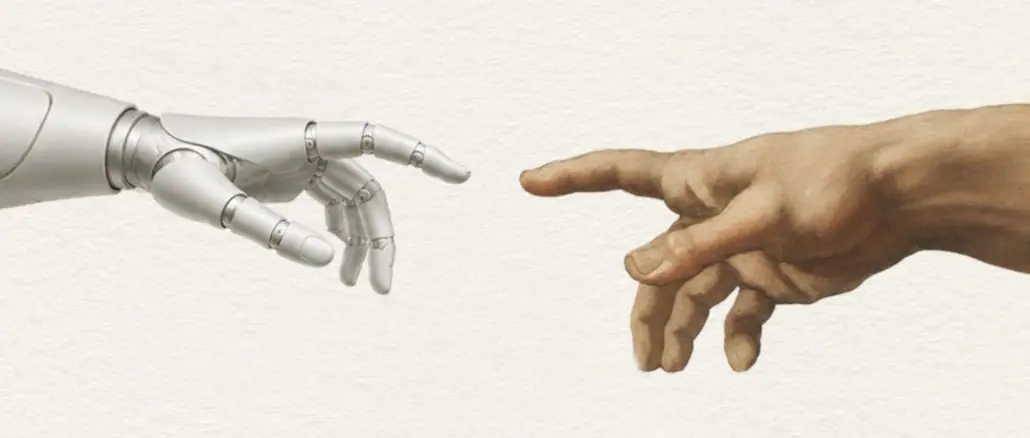
The cover of Remuseum’s Five Ways AI Can Humanise Museums has the somewhat cliché image of Adam’s Sistine Chapel hand reaching out to a robotic simulacrum of God’s. It begs all kinds of questions – shouldn’t the machine be reaching out to us, if it’s supposed to help? Is the human hand representing the museum’s management, seeking the power to create new worlds? Or a casual visitor, eager to understand something / anything? Should we read anything into the way the hands aren’t actually touching?
Remuseum is a consultancy that aims to promote innovation among art museums across the United States. It’s effectively the brainchild of its founding director Stephen Reily, former director of the Speed Art Museum in Louisville, KY, and he’s the author of this report.
His core argument is that AI can make museums “more personal, accessible, operationally capable, and recognisably themselves”. Importantly, it argues that avoidance is not a realistic strategy: staff, artists, and audiences are already encountering AI through workaday tools such as search engines and workplace software. And negativity is equally retrograde: museums should not start from the view that AI is primarily a threat to employment or, perhaps more relevantly, a diminution of the way people might encounter art.
So the report is emphatically pro-adoption, but not ‘technology first’. It argues for the value of governance and “institutional purpose”: rather than relying on informal and unmanaged use of AI, museums should train staff and govern its use quite deliberately. Its recurring formula is to begin with the museum’s mission – artistic encounter, scholarship, accessibility, staff expertise, donor relationships – and use AI where it advances that mission.
Thankfully, it’s not merely evangelical. The report is based on case studies from major American art museums, and its meaty centre looks at five practical cases:
The Detroit Institute of Arts example looks particularly persuasive. Rather than a costly rebuild of existing but fragmented databases, it proposes an AI layer over existing systems so staff can retrieve connected information through natural-language questions; the intention is also to open-source the work for other museums. The cost saving is substantial.
At the other end of the budget scale, we also liked the Frye case. The branding/voice exercise cost $7,500; it resulted in 20 percent growth in repeat web traffic and 18 percent higher attendance (comparable Seattle museums were reportedly down 15–20 percent). The report stops short of attributing causation, but at least it suggests that AI can scale a distinctive human voice rather than standardise it.
Overall the report is commendably to the point when it comes to the lack of glamour in the basic but most valuable work – joining fragmented datasets, improving metadata, building governed workflows, writing style guides, and investing in fibre, location awareness and computing capacity. An engaging chatbot or a whizzy image-recognition interface is treated as merely the visible tip of a much larger iceberg-sized organisational and data project.
On the other hand it seems to downplay some potential areas of concern. For instance, visit data – say, time spent with a particular work – could be used to engage visitors into curator conversations, for instance, and ideally longer-term relationships. That is a powerful fundraising and audience-development proposition, but it also raises consequential questions about consent, surveillance, and whether visitors want their attention measured in the first place. How do you ask someone who’s been looking at painting for a while whether they mind being tracked?
Overall, through, the report takes an optimistic if pragmatic view of the value of AI in this sector. Those case studies demonstrate the conditions required for humanisation, whether via AI or not: we need human-authored standards, curatorial oversight, secure enterprise tools, staff training, public transparency, accessible data, feedback mechanisms, and meaningful governance. AI alone is not presented as humanising; institutions make it so through design and policy.
Five Ways AI Can Humanise Museums is available as a free download here.
Be the first to comment