
Frieze Abu Dhabi
Building on nearly two decades of Abu Dhabi Art, the inaugural edition of Frieze Abu Dhabi marks a new chapter for the region’s international art scene. The aim is to connect Abu Dhabi and local arts ecosystem with Frieze’s global network of galleries, artists and collectors; the more immediate concern will of course be the incipient conflict in the Gulf, but at time of writing the fair is going ahead with much optimism and enthusiasm.
So what’s changed from the last Abu Dhabi Art in November 2025? Some obvious elements are retained – the fair’s location, the involvement of DCT Abu Dhabi, the presence of Dyala Nusseibeh as fair director. But there are also some significant points of difference, quite apart from the scale of the fair itself (Abu Dhabi Art’s final edition had more than 140 galleries, Frieze has 80 or so).
Frieze describes the exhibitors for its first Abu Dhabi edition as a “tightly selected group” who have been given with larger stands and a more generous layout intended to encourage “sustained engagement”.
There’s a solid base of top UAE galleries – Carbon 12, Lawrie Shabibi, The Third Line, Tabari Artspace, Iris Projects, Gallery Isabelle, Green Art Gallery among others – with some of the big names from Saudi Arabia (Athr, Hafez) and Lebanon (Saleh Barakat, Mark Hachem, Galerie Tanit).
Frieze’s international reach is presumably responsible for the strong showing from London – among them Thaddaeus Ropac, Richard Saltoun, Timothy Taylor, Victoria Miro, Vigo Gallery, Voena and Waddington Custot – alongside a smattering of European galleries. There’s also some blue-chip New York names: Gagosian, Pace, Vito Schnabel and Leila Heller (the only one of that cohort to have a UAE outpost).
The other commercial section is Focus, a long-standing Frieze feature for younger international galleries showing experimental solo or dual presentations. Frieze Abu Dhabi is offering bursaries for each gallery in this section to encourage them to show locally. For 2026 it’s a modest group of just six galleries .
The fair will also have two curated sections. Frieze Masters Abu Dhabi is curated by Marika Sardar, an art historian and curator whose expertise focuses on the historical networks of the Indian Ocean. That shapes the content of Frieze Masters Abu Dhabi, which we’re told will present “exceptional objects and artefacts from West Asia and beyond, spanning Antiquity through to the early 20th century … shaped around the theme of the Indian Ocean, encompassing the historic movement of objects, people and ideas through trade, collecting and cultural exchange”.
And the more contemporary equivalent is Global Futures, a series of gallery presentations for solo artists whose practices engage with histories and ideas that resonate across the UAE and the wider region – “bringing together artists from distinct cultural contexts, the section will trace connections across place, material and lived experience, situating their work within the broader regional and international dialogues that Frieze Abu Dhabi seeks to foster”.
The scale of the curated element is rather different to Abu Dhabi Art’s last programme. The predecessor fair seemed to feel it had a remit to promote and document the local art scene: so we had the Pavilion Prize for student designers, the Beyond commissions for new works by emergent UAE-based artists (which in the past had travelled internationally after the fair), the guest-curated Gateway programme of installations, a performance programme, and site-specific projects around Abu Dhabi and Al Ain.
And Abu Dhabi Art had no door charge; previous versions did have an entrance charge but last year was free with online registration, whereas Frieze Abu Dhabi will be charging a very specific AED 57.75 per day for general admission (AED 236.25 for a three-day pass).
The overall impression is that Abu Dhabi Art had wider aspirations and probably less measurable KPIs. Frieze Abu Dhabi is more specific in its goals, a commercial art fair that seeks to contribute to Abu Dhabi’s soft-power positioning as a high-end cultural destination. In short, Frieze Abu Dhabi seems to be going for less volume and more quality: certainly the curated programming sets a high bar.
The inaugural Frieze Abu Dhabi Artist Award is curated by Nabila Abdel Nabi, Senior Curator for International Art at Tate and head of the Hyundai Tate Research Centre: Transnational, who selected the Lebanese (London-based) artist Dala Nasser as its recipient.
The award will support a new commission, Nasser’s ambitious site-responsive work Qubbat Duris; this takes its name from a 13th-century monument in the Bekaa Valley, a structure which reflects the transcultural history of the region. Nasser’s installation offers a reflection on the ways materials carry memory over generations, and on a collective responsibility towards landscapes facing destruction.
In Dialogue is a new annual flagship exhibition. Dirwaza Curatorial Lab has titled this one ‘At Another Meeting Point’ and paired works by Mohammed Kazem and Alia Zaal, “opening up new perspectives and unexpected points of connection across generations”. This sounds promising.
Frieze Sculpture Abu Dhabi is a nod to the London-based parent, with works from Zeinab Alhashemi, Mohamed Ahmed Ibrahim, Imran Qureshi, and Kamran Samimi.
Timings:
19 November (Invitation only) 2pm – 9pm
20 November 2pm – 9pm
21 November 2pm – 9pm
22 November 2pm – 9pm
Entry to the fair is date- and time-specific, with no re-entry for one-day general admission tickets.
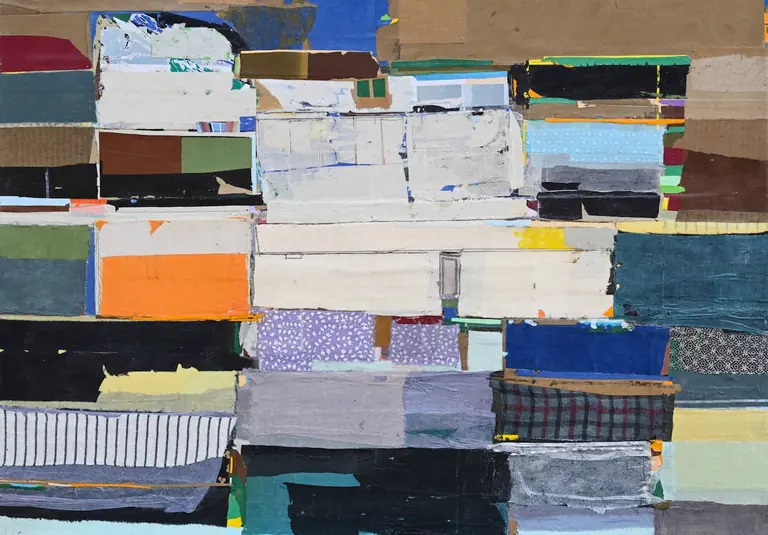
Image: Mohammed Joha, No Shelter 01 (2026). Courtesy of Zawyeh Gallery and the Artist; showing in the Global Futures section
WEB LINK