
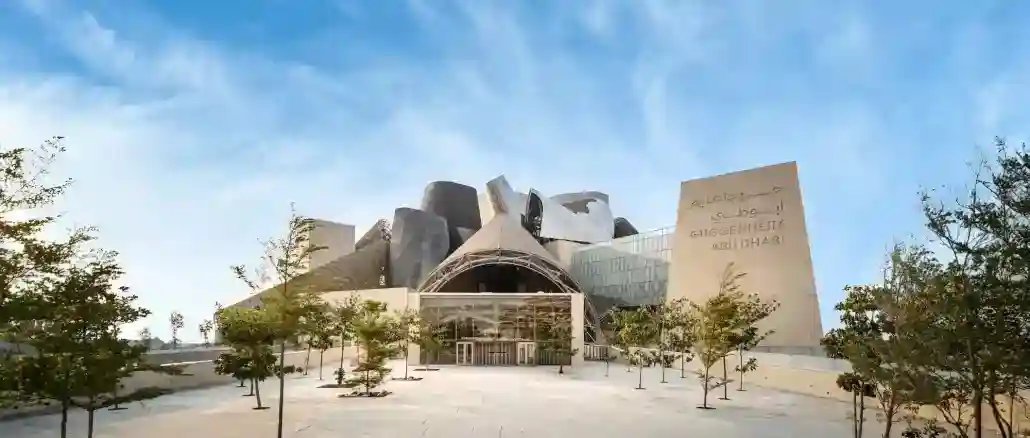
It may have taken 20 years, but at last we have a firm opening date for Guggenheim Abu Dhabi. On 11 December it joins New York, Venice and Bilbao in the Guggenheim Foundation’s desire to bring post-1960s art to the world in stunning buildings.

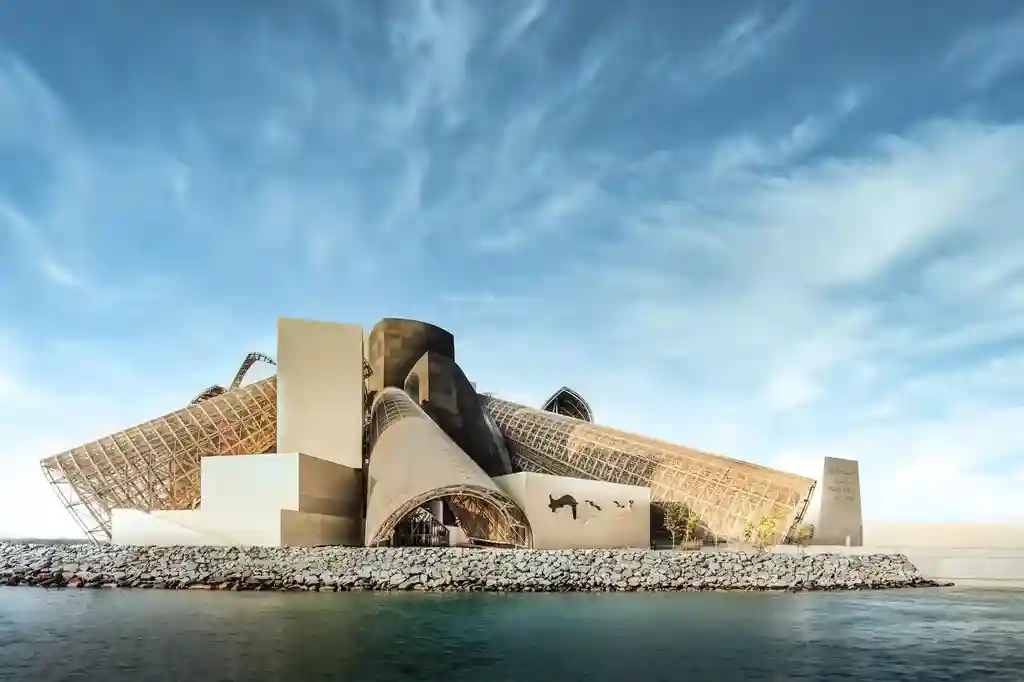
Designed by the late Frank Gehry, Guggenheim Abu Dhabi features ten sculptural cones that punctuate the building’s skyline – nine clad in stainless steel mesh and one in onyx and glass – reaching heights of up to 88m and providing natural ventilation and shade. It’s impressive, yet (hopefully) functional.
It’s also big. Inside there are 30 galleries connected by a central atrium, a total of 11,600 square metres of interior space; there’s another 23,000m² of exterior exhibition space in the cones and terraces around the building.
That makes Guggenheim Abu Dhabi the largest Guggenheim museum by overall building size, and still the largest in terms of indoor exhibition space (Bilbao has about 9,000m²).
It will also be the largest in the UAE – the nearby Louvre Abu Dhabi has about 9,200m² of permanent galleries, so the Guggenheim would appear to be 26% larger even before you include its outdoor exhibition areas. (As yet there are no floorspace figures for the proposed Dubai Museum of Modern Art, the only other potential competitor size-wise; Tadao Ando’s design runs to five floors but reportedly only two of them are for exhibition space.)
The official word is that the museum will offer “new perspectives on modern and contemporary art from an Abu Dhabi lens … Guggenheim Abu Dhabi reflects a transcultural approach, moving beyond chronology and geography to highlight artistic lineages, networks, and exchanges”.
It has actually been building its collection since 2009, with a broad range of media – as you’d expect from a Guggenheim – but with a specific emphasis on artists from West and South Asia and North Africa (WANASA, apparently) and a policy of presenting what’s described as “a global history of modern and contemporary art” (rather than a Western-centred narrative) that will examine “points of intersection and transcultural exchange”.
Guggenheim Abu Dhabi was first announced in 2006, but the global financial crisis of 2008-9 prompted a more cautious approach to capital expenditure – instead of building all the projects all at once, the government elected to stagger investment in Saadiyat Cultural District. This would also seem to make more sense in terms of marketing, though last year saw a rush of openings:
Dr Mariët Westermann, formerly of NYUAD and now Director and CEO of the Solomon R Guggenheim Foundation, described Guggenheim Abu Dhabi’s collection elegantly as “uniquely local and global, centred in the region but with works from all continents.”
As well as its exhibitions, Guggenheim Abu Dhabi plans to support artists through commissions, research, exhibitions and a multilingual public programme. It will be interesting to see the commissioning policy …
“Rooted in Abu Dhabi and built for the world”, says the blurb. That seems to us to be the wrong way around. We’ll have to see how the collection and the curation pan out in practice, but Guggenheims (and maybe all art museums) seem to be more about bringing the world to the location. The principle (Guggenheim’s roots?) lies in presenting modern and contemporary art from around the world to a local audience, “shining a light on art and artists” as the blurb continues. Maybe “rooted in the world and built for Abu Dhabi” would be more appropriate.
The timeline:
More information is available from the official press release here, and much more should be available on the website – though at the time of writing it’s still under construction, ironically enough. You can still sign up for emails, though.
Be the first to comment